Monday, May 14, 2012

Jim Laughter's new ''cli fi'' novel 'Polar City Red' revolves around sex lottery in future "polar city"


Jim Laughter in Oklahoma has written a game-changing cli fi novel

about mankind's shaky future on this third rock from the sun, and his

new book, titled “Polar City Red” is out now from AWOC Books in Texas,

I've read the book, of course, and I can tell you this: climate

denialists are going to say it's not science, and die-hard climate

activists are going to say it's just fiction. Go figure. Lovelock?

He'll love the book. In

fact, the jacklet cover has a James Lovelock quote!


One of the parts of the book that is sure to rattle the cages of some

readers is the theme of a sex lottery that ensures the continuation of

the human species

in a post-climate chaos world. Read the book to see what Laughter is

doing here: it's not for the squeamish, although, no, it's not

X-rated, at least not in the book.


Maybe for the Hollywood movie, sure.
Jim Laughter's new ''cli fi'' novel 'Polar City Red' about the dark
future of global warming
revolves around sex lottery in future "polar city". Think
breeding pairs in the Arctic and sex lotteries among polar city
residents. It's a major theme of the book. Safe for work but at the
same time NSFW.

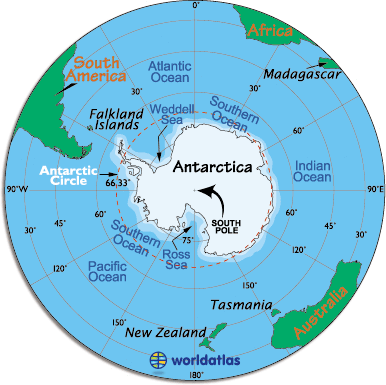
Let's RENAME Antarctica with a better name for the 21st Century

Let's RENAME Ant-----arctica with a better name for 21st century and beyond that does not mean just merely *OPPOSITE* THE ARCTIC..so boring...... but has its own particular nw NAME,...


open to suggestions...

I mean the ARCTC is a GOOD name for the Arctic. But the south pole area should NOT JUST BE CALLED *ANTI*-Arctic.......any ideas for better name?


The first formal use of the name "Antarctica" as a continental name in the 1890s is attributed to the Scottish cartographer John George Bartholomew. The name Antarctica is the romanized version of the Greek compound word ἀνταρκτική (ant-arktiké), feminine of ἀνταρκτικός (ant-arktikos),meaning "opposite to the Arctic", "opposite to the north". OKAy, for those days, 1890s, there were no airplanes or computers or instant messages or even INTERNATIONAL research bases in ANTARCTICA...... but NOW in 2012 it's time to give that area of our world a better name, more APT....


I suggest two names for possible consideration and would like to hear MORE NOMINATIONS from others aroudn the world:


1. Penlandia...[for Penguin Land]


2. Penarctica....for Penguin COLD PLACE, so PEN ARCTIC and the ICA at the end for the sound and feel. so PEN ARCTI CA, since penguins are symbols of South Pole area, and they do NOT live in the Arctic regions.....


I like both names. Which name do u like best? and more important, WHAT OTHER NAMES would you like to suggest for this southerm land mass?


send details and replies here: or leave comments here or at


danbloom ATMARK gmail.DOT com

Sunday, May 13, 2012

How the images created by Deng Cheng-hong influenced the writing of POLAR CITY RED, a cli fi nvoel set in 2075 A.D.

Jim Laughter, the author of POLAR CITY RED, available now at Amazon and as a POD paperback from AWOC Press in Texas, explains:

"In the summer of 2011, Dan Bloom, the American director of the Polar Cities Research Project in  Taiwan , sent me online photographs of Mr. Deng's ideas like those above which were about what a house in a polar city would look like. To me, Deng's images, reminded me of a livable land-based iceberg with only a small portion of it above ground and the rest of it descending deep into the Earth. I adapted some of the housing in Polar City Red to conform to Deng's ideas.''


Jim Laugher adds:

"Mr. Deng's idea is probably more practical than mine, but for my novel, which is pure fiction, I decided to go another away. I chose to use a mix of modern geodesic domes (the scientific aspect) and a frontier gold-rush city theme with lean-to shacks, improvised housing made from salvaged truck trailers, tents, wooden and rock structures, etc,. If a person were to approach Polar City Red, they would see science and survival in a single glance. The population of Polar City Red are also a mix of highly educated people (the science) and ordinary people who've escaped the climate chaos of the lower 48 and the other continents and migrated north to save their own lives. "

"I'm very grateful to the botanical gardens in St. Louis, Missouri for allowing me to use their geodesic dome, The Climatron, as the primary setting for this book. How did I get the Climatron to the Arctic Circle? You'll have to read the book to find out."


''Is the book real or fiction? Global warming is real. The climate choas is real. The book is fiction laced with just enough science to make it feel real. I'll let readers make up their own minds between fact and fiction.''


Saturday, May 12, 2012

Oklahoma author tackles climate change


Oklahoma-based author Jim Laughter has added ''climate thriller author'' to his accomplishments with the publication of POLAR CITY RED, seen above.


TULSA, OKLAHOMA -- Jim Laughter isn’t one to wait around for someone else to come up with a solution to a problem. A well-regarded Oklahoma writer, the retired father of three and grandfather of four, wants to do whatever he can to effectively get the climate change message out to as many people as possible. The end result is his new climate thriller POLAR CITY RED.

“Seeing my life in its entirety, I believe every generation has a duty to leave the world better than they found it,” the 59-year-old said. “We must make sure we do everything we can, and do a better job educating the public, especially the children who will eventually fill our shoes.”

Global warming and climate change are complex environmental issues with varying opinions as well as facts available from numerous sources. In his novel, Laughter provides a broad yet comprehensive overview of the climate issues facing the world today, all in the guise of pure fiction.

Written in page-turning style, and available in both paperback and eBook formats, his 200-page climate novel offers explanations on how the seeds of climate change were planted during the Industrial Revolution, what can be done to stop it, how each individual can help, as well as outlining basic scientific principles. It's also one heck of a good read and a great story -- a dramatic family novel that will spark your imagination with questions that lead back to the basics of creation and universal family values.

“I wrote a book that I hope others will read and enjoy,” Laughter said. “Some of the non-fiction books out there about climate change are intimidating because of their length and the scientific mumbo-jumbo that the average reader can't understand. My novel is pure entertainment, but with an important message about climate change, too. It's a wake up call.”

“It’s been both an evolution and a revelation writing this novel,” Laughter said. “Although it wasn't my strongest subject in school, I’ve always had an interest in science, all science. Now with global warming issues, I am very concerned for the future of our planet and our descendants."

Part of that evolution can be attributed to his desire to make the world a better place for his grandchildren. Laughter said that he learned a lot from reading and doing research about climate change, and that’s when he got interested in the whole issue.

Laughter would like to see America take a more prominent leadership role at home and on the world stage on climate issues before it is too late.

"America has always been an environmental leader when it comes to policy and politics, but I’d like to see us lead by example, not just by mandate,” he said. “Even if the climate crisis wasn’t an issue, we need to lessen our dependency on oil, especially imported oil. As long as we have a sun, we are going to have solar and wind power. We must to find ways to look to renewable sources that can generate jobs and income. We must do absolutely everything we can if future generation will have a habitable atmosphere.”

Laughter has always had a love of writing. His books include a co-authored young adult sci-fi series, an illustrated children's book, a psychological thriller about a religiously-induced serial killer, and a nationally-endorsed true crime novel about child kidnap victim Steven Stayner. All of his novels are available in paperback and eBook.

Laughter added, “I like the feature of writing that you can get ideas that matter out to people. It's a worthy calling.”

Ten questions to Dan Bloom on backstory of POLAR CITY RED

1. Dan, you served as producer and packager of this internatinal book by Jim Laughter. Can you explain what this entailed? IT ENTAILED BEING THE CHIEF COOK AND BOTTLE WASHER IN TERMS OF SETTING UP THE PR CAMPAIGN, THAT'S ALL. I CAME TO THE PROJECT WITH THE THEME AND THE TITLE, AND JIM LAUGHTER PULLED IT OFF WONDERFULLY. IT IS ENTIRELY HIS BOOK.  I WAS JUST THE BACKROOM GUY, THE BACKGROUND MAN. JIM DID ALL THE HEAVY LIFTING. IT's HIS BOOK!


2. Did you commission the novel or did the author approach you first? I ASKED THE AUTHOR A YEAR AGO, MORE OR LESS, IF HE HAD TIME AND INTEREST TO WRITE SUCH A NOVEL. HE CAME TO ME HIGHLY RECOMMENDED BY AMERICAN CRIME WRITER CHUCK SASSER. WE CLICKED IMMEDIATELY AND HE SAID YES. SEVEN MONTHS LATER, HE HAD THE BOOK DONE.


3. Do you stand to make any money from this book as the producer/packager? NO.


4. Your name is mentioned in the book preface as " to my friend Danny Bloom, a visionary"...... but your name is not on the cover of the book . Why not?...BECAUSE I DID NOT WRITE ONE WORD
OF THE BOOK. IT IS ALL HIS BOOK.


5. Did you write any parts of the book? NO. JUST THE TITLE.


6. Did you give the book it's title? YES. THAT WAS MY IDEA. THAT WAS MY ONLY CONTRIBUTION TO THE BOOK.


7. How did you find Jim Laugher in the USA to write the book? Did you pay him an advance?
I FOUND HIM BY LUCKY CHANCE FROM A RECOMMENDATION FROM A FRIEND IN OKLAHOMA WHO KNEW JIM AND SAID HE MIGHT HAVE TIME WRITE SUCH A NOVEL.
THERE WAS NO ADVANCE PAYMENT. I HAVE NO MONEY! I AM A POOR MAN IN PARADISE!


8. How did Mr Laughter know so much about globl warming?...is he a scientist? HE DID RESEARCH AND HE READ A LOT ABOUT THE ISSUES. HE IS  A SMART MAN.


9. Why do you care so much about this topic? and why did you spend so many years looking for a writer to write this book?  I CARE BECAUSE I CARE. THIS IS MY LIFE's WORK NOW, PROMOTING THE IDEA OF POLAR CITIES FOR SURVIVORS OF CLIMATE CHAOS IN SOME FUTURE TIME. MY TIME FRAME IS AROUND 2500 AD. JIM FELT THE BOOK WOULD BE BETTER SERVED IF THE TIME FRAME WAS MORE IMMEDIATE. I AGREED WITH HIM AND SAID DO IT YOUR WAY. HE DID.


9.5 Is a novel really that important in relation to scientific discussions about climate change? YES. ART AND LITERATURE HAVE MUCH TO SAY ON THIS TOPIC, TOO. SURE.


10. What exactly does a book producer/packager do,.... or is this just a vanity title you gave yourself? SEE ABOVE.


OPED New York Times (submitted) "Cli fi' novel about global warming is chilling

This oped piece was sent to the New York Times for publication in print and online.

'Cli fi' novel about
global warming
is chilling


by Ememt Matridah


I have seen the future and it's dank, dark and dystopian -- and it

takes place in Alaska. At least in one Oklahoma author's eyes, it

does.


Last year, as a newbie book producer, I commissioned novelist Jim

Laughter in Oklahoma to write a book about mankind's shaky future on

this third rock from the sun, and he immediately said yes. The novel,

titled “Polar City Red,” is out now, and the entire story, from page

one to the final paragraph, belongs to Mr. Laughter. His name is on

the book cover, not mine, and all profits, if any, go to him. It's his

book.


What did I do? I gave it its title, and I suggested, as a former

Alaskan, its theme and its setting in Fairbanks. Jim wrote the entire

yarn, creating his own cast

of characters and giving it his own time frame. I originally suggested

setting it in 2500, some 30 generations from now. Jim decided to set

the story

in 2075, to give it a more immediate and closer to home feel. He was

right to do so.


Having read the book, I can tell you this: climate denialists are

going to say it's not science, and die-hard climate activists are

going to say it's just fiction.


Laughter's “polar Western” is set in the Last Frontier just 60 years

from now, and it poses a very important and headline-mirroring

question: Will mankind survive the “climapocalypse” coming our way as

the Earth heats up over the next few centuries? The end is not coming

in 100 years, but it might happen by 2500 A.D.


In Jim's book, sea levels rise and millions of “climate refugees” make

their way north to Alaska. Think scavenger camps, “Mad Max” villages,

and U.N.-administered “polar cities” — cities of domes, as the author

calls them.


“Polar City Red” is more than mere science fiction. Laughter, a

retired grandfather of four, comes across as a probing moralist and a

modern Jeremiah. His worldview befits a former Christian pastor who

built two churches and finds in his inherited religion both an anchor

and a place for hope.


And his book is not just about climate change or northern dystopias.

It's also about the moral questions that must guide humanity as it

tries to keep a lid on global warming's worst-case scenarios while

also looking for solutions to mankind's worst nightmare: the possible

final extinction of the human species due to man's own folly and

extravagant ways. Can a small 150-page novel do all that? No, it's

just entertainment, fiction, science fiction, a good book to put on

your summer reading list.


Writing the novel took Laughter seven months of research and

keyboarding, but I have a feeling that what he wrote will last 100

years..


It's more than a “cli-fi” thriller. It also exposes the underbelly of

humankind's most terrifying nightmare: the possible end of the human

species and God's deep displeasure at what His people have done to His

Earth.


The book is prophetic, futuristic and moralistic. As a reader, you

will get through this one alive. But will our descendants, those in

Alaska and those in the Lower 48, survive the Long Emergency we find

ourselves in now? That's the question that Laughter poses. And you

don't have to believe in global warming to enjoy the story.


I can tell you this: the book ends on a note of hope and redemption,

so it's not a downer at all. “Polar City Red” might inspire you or it

might annoy you, but as the world heads closer and closer to climate

chaos, even in Alaska, Laughter's book sounds an ominous note. I'd

read it if I was you.


----------------------------------


Matridah is a former editor of Capital City Weekly in Alaska and now works as a

book producer and packager. His climate blog can be accessed at

http://pcillu101.blogspot.com/

Polar Cities Redux: part 3 -- Polar Cities a Haven in Warming World?

One vision of a “polar city”. (Illustration by Deng Cheng-hong)

Dan Bloom, a freelance writer, translator and editor living in Taiwan, has been on on a campaign to get people to seriously consider a worst-case prediction of the British chemist and inventor James Lovelock: life in “polar cities” arrayed around the shores of an ice-free Arctic Ocean in a greenhouse-warmed world. Of course, in a recent interview with Ian Johnston at MSNBC, Lovelock backtracked a bit on his time frame, saying the shite won't hite the fan until around 2500 AD or so, not 2100 as he earlier "predicted." But Lovelock still believes in climate change and global warming, but now at age 93, he says it will happen much more slowly, glacially in fact, than he had earlier said in 2006.

Dr. Lovelock, who in 1972 conceived of Earth’s crust, climate and veneer of life as a unified self-sustaining entity, Gaia, still foresees humanity in full pole-bound retreat within a century as areas around the tropics roast — a scenario far outside even the worst-case projections of climate scientists. But the time frame has been moved back to 2500 or so.


After reading a newspaper column in which Dr. Lovelock predicted these earlier disastrous warming, Mr. Bloom (a frequent comment poster on Dot Earth) teamed up with Deng Cheng-hong, a Taiwanese artist, and set up Web sites showing designs for self-sufficient Arctic communities. Now he has teamed up with Oklahoma novelist Jim Laughter to produce and package the world's first cli fi novel about polar cities, titled POLAR CITY RED, and written entirely by Mr Laughter himself.


Mr. Bloom told me the New York Times in 2008 that his intent with his PR campaign to raise public awareness about polar cities was to conduct a thought experiment that might prod people out of their comfort zone on climate — which remains, for many, a someday, somewhere issue. Now, with Mr Laughter's novel, POLAR CITY RED, the ideas about polar cities have entered the realm of literature and science fiction, what some call CLI FI even.

Andrew Revkin of  the New York Times interviewed Dr. Lovelock some years ago on his now-recanted dire climate forecast and prescriptions — and also his ultimately optimistic view that humans will muddle through, albeit with a greatly reduced population. There’s a video of the chat with Dr. Lovelock at Dot Earth.


“At six going on eight billion people,” Dr. Lovelock told Revkin in 2006, “the idea of any further development is almost obscene. We’ve got to learn how to retreat from the world that we’re in. Planning a good retreat is always a good measure of generalship.”


The retreat, he insists, will be toward the poles. And it still will be, despite the MSNBC viral interview. Lovelock has not really changed his mind, just the time frame of climapocalypse. So Jim Laughter's novel still stands and still has something important to say. Read it.


It’s a dubious scenario, particularly on time scales shorter than centuries. But — as Dot Earth has  written extensively in recent years — there is already an intensifying push to develop Arctic resources and test shipping routes that could soon become practical should the floating sea ice in the Arctic routinely vanish in summers.


Sensing the shift, the U.S. Coast Guard has proposed establishing its first permanent Arctic presence, a helicopter station in Barrow, Alaska, the northernmost town in the United States.


It’s not a stretch to think of Barrow as a hub for expanding commercial fishing and trade through the Bering Strait.


The strategic significance of an opening Arctic recently made the pages of Foreign Affairs magazine, in an article by one of my longtime sources on this issue, Scott Borgerson, a former Coast Guard officer who is now a scholar at the Council on Foreign Relations.


“It is no longer a matter of if, but when, the Arctic Ocean will open to regular marine transportation and exploration of its lucrative natural-resource deposits,” he wrote.


So even if humanity isn’t driven to Arctic shores by climate calamity at lower latitudes, it’s a sure bet that the far north will be an ever busier place. Urban planners, get out your mukluks.


In the meantime, scientists, marathon runners, and others are already making the North Pole a busy place. And Jim Laughter's novel is sure to wake a lot of people up! Read it this summer for sure!